Network social participation for population with psychiatric disabilities:Transliteracy, archives and memorial activities

image1

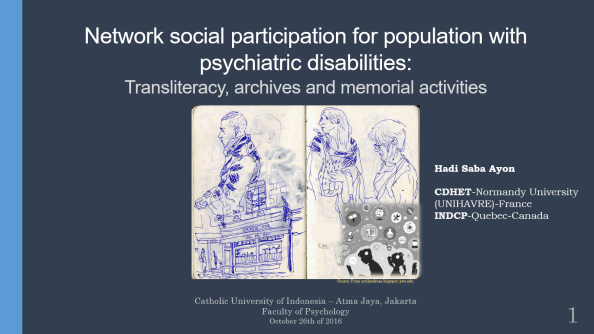
How can the environment affects the social participation of persons with psychiatric disability? Based on the understanding of the disability in an anthropological and systematic approach as an interactive process (Fougeyrollas, 2010), our research perspective tries to introduce the digital culture (Doueihi, 2013) in the activities of the person in order to overcome the situation of disability. The procedure consists on developing new literacies and building an inclusive/adaptative environment.

This presentation took place in the Faculty of Psychology in Catholic University of Indonesia – Atma Jaya in Jakarta on October 26th of 2016.

To check the presentation: https://drive.google.com/open?id=0B0pzbHXvgDK8SWRUNjZzSVZZTW8


From social interaction to digital trace

image1

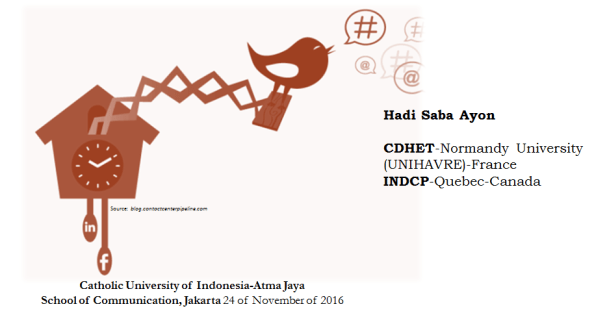
The passing from the technical computing to the cultural uses in the digital, or the passage from “computing” to “digital” (Doueihi, 2011), rewrotes the social interaction. The latter, being a process of interpretation and definition, lost the symbolic aspect (Mead, 1934) by which people establish the meaning of actions and gestures of others, and indicate in return how they would react. We are therefore faced with a paradigm shift from the interaction to traceability in an environment where we can’t not leave traces (Merzeau, 2009).

This general lecture was held in the School of Communication in Catholic University of Indonesia – Atma Jaya in Jakarta on October 24th of 2016.

To read it: https://drive.google.com/open?id=0B0pzbHXvgDK8MDJEVFo3ZEVMb2s

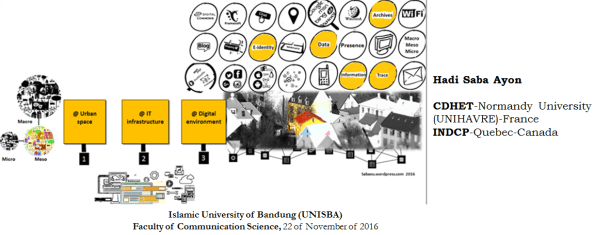
Digital trace, Big Data and privacy: Advantages and limits?

photo-1

What is digital and how does it change our life and affects our privacy?

As an environment, the digital gathers traces produced by users’ activities. Most of them are created unintentionally,  and share lots of personal information. Once they are combined and calculated, these traces can give a meaning to the behavior, the interests and the personal habits of digital users.

Based on several researches of the French school on Trace, we approach the problematic of privacy in the digital era, and call for a digital education to safeguard personal data and develop protection solutions. Appropriating traces in memorial projects is performed by passing from the traceability of persons to the traceability of content (Merzeau, 2013).

This presentation took place in the Islamic University of Bandoung (UNISBA) in Bandoung – Indonesia on October 22th of 2016.

To read it: https://drive.google.com/open?id=0B0pzbHXvgDK8NnZtZFZSd2RmUkU