De la réalisation des habitudes de vie à la re-documentarisation des traces : Le numérique pour une “participation sociale en réseaux” des personnes ayant des incapacités psychiques

Résultat de recherche d'images pour "ALTER handicap"

Penser la participation sociale de la personne ayant des incapacités à l’ère du numérique conduit à questionner ses habitudes de vie (Fougeyrollas et al., 1998, 2010) et le processus de sa réalisation. Souffrant d’un dysfonctionnement de comportement et perturbée dans son adaptation sociale (Sarfaty, Zribi, 2008), la personne ayant de troubles psychiques se trouve dépendante dans ses activités courantes et rôles sociaux de ses accompagnateurs. Comment ces derniers appréhendent-ils sa participation sociale ? Que disent-ils du numérique ? Comment la culture numérique (Doueihi, 2011) pourrait-elle favoriser cette démarche et quels changements apporterait-elle ? Peut-on parler de nouvelles habitudes de vie numériques dans un environnement de traces (Mille, 2013) ? Nous interrogeons sur ces questions, un groupe de personnes appartenant à la « fleur relationnelle » (Colloc, Léry, 2008) des personnes ayant des incapacités psychiques à Rio Branco (Acre) au Brésil en 2016. Notre approche méthodologique est qualitative. Elle comprend un questionnaire et des entretiens semi-directifs. L’analyse thématique de contenu montre la difficulté des accompagnateurs de définir la participation sociale comme processus. De plus ils l’associent à des pratiques citoyennes et à des activités numériques collaboratives. Nous proposons un modèle de “participation sociale en réseaux” pour achever une présence numérique (Merzeau, 2010) active. A cette finalité, nous soulignons l’importance de mettre sur pied une translittératie (Merzeau, 2014) qui habilite le pouvoir individuel et collectif des personnes ayant des incapacités psychiques d’agir sur leur environnement. Nous appelons également à l’appropriation des traces numériques dans de contributions mémorielles et à la re-documentarisation (Salaün, 2007) de contenus. L’objectif est l’organisation des habitudes de vie numériques sous forme de reconstruction des ressources et d’archivage permettant une expérience partagée.

Ce travail fut présenté dans la Conférence Handicap, Reconnaissance et “Vivre ensemble”. Diversité des pratiques et pluralité des valeurs, organisée par la Société Européenne de Recherche sur le Handicap (ALTER) à l’Université de Lausanne en Suisse les 6 et 7 juillet 2017.

Programme complet de la conférence.

Voir le support de la présentation : https://drive.google.com/open?id=0B0pzbHXvgDK8US02T0NFYW8xdEE


The relationship with space in the digital era: a reinvention of the identity and the environment

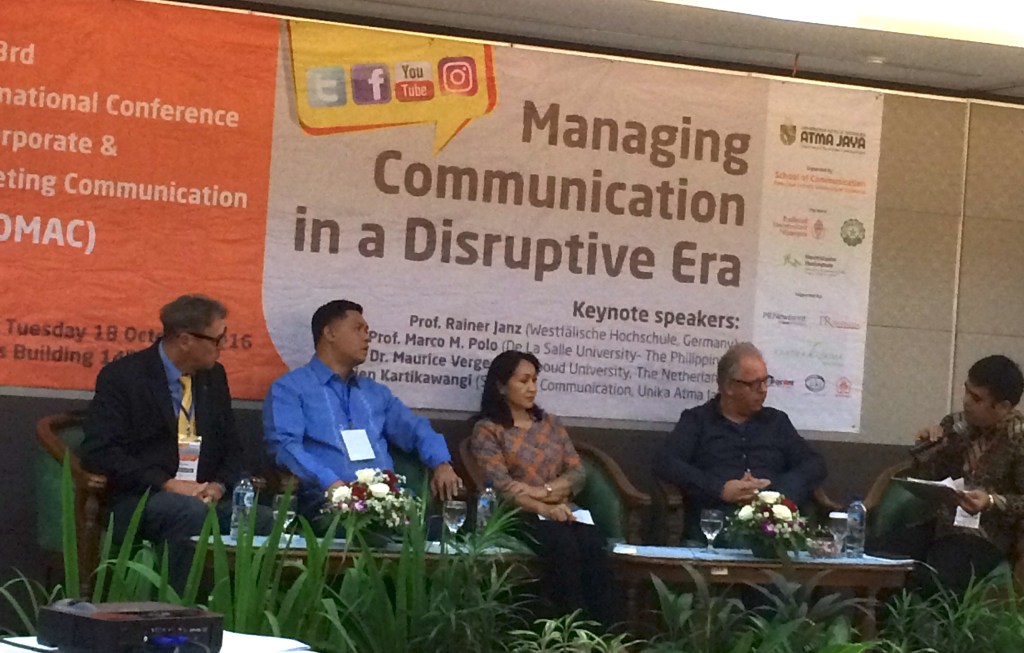
Managing communication

This paper is published in the Proceeding Book “Managing communication in a disruptive era” (p. 73-86), by Atma Jaya Catholic University of Indonesia in Jakarta on April 2017.

It discusses the socio-cultural aspects of uses of geolocation (the case of Facebook Places application), and inspects the “editorial content” of urban space through location-marking services.

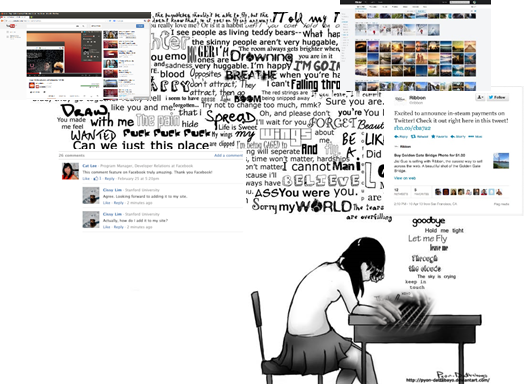
Geolocation associates territories and networks, the material and the immaterial, analog and digital. Hybridization of space also requires consideration of the body, of the disembodied identity and of the inter-spatiality. But does the use of these location-based applications consist only of curiosity to know where the other is, or does it make part of the construction of identity in the digital environment? Does publicly disclosing our movements count as an act of showing off, of linking relationships, or is it simply a form of expressing the link between the spatial dimensions of the action?

By exploring and listing all existing places, the “urban explorers” discover, unmask and reveal relationships and places, sometimes hidden to the eyes of all. They move entire parts of a city from Nature to Culture.

Digital culture and social participation of persons with disabilities

image

How can digital culture insure the social participation of population with disabilities?

Referring to the Human Development Model- Disability Creation Process (Fougeyrollas, 2010), we believe that disability occurs in the interaction between personal and environmental factors. This process affects one’s life habits (INDCP) and subsequently their social participation.

In the digital environment, users develop new social and cultural uses. One new life habit shared by many digital users is the editorialization. According to Bruno Bachimont (2007), the concept of editorialization designates an editorial activity from the indexed fragments of a document. The aim is no longer to find a document but rather to produce new ones using new resources.

Searching for online content and combining fragments of documents to generate substance, is a new way of writing/living in the digital. We believe that a person with disability can achieve an ample part of their network social participation by developing their online presence (Merzeau, 2010) and managing new forms of digital writing.

This general lecture was held in Al-Azhar University Indonesia in Jakarta on November 29th of 2016. To check the presentation: https://drive.google.com/open?id=0B0pzbHXvgDK8ZmZfaXBQdXNsRmc

To watch the interview : https://drive.google.com/open?id=0B-kLciZhjIfXZjBsZG1LVy11Z28

interview-with-hadi-s-a