Digital culture and social participation of persons with disabilities

image

How can digital culture insure the social participation of population with disabilities?

Referring to the Human Development Model- Disability Creation Process (Fougeyrollas, 2010), we believe that disability occurs in the interaction between personal and environmental factors. This process affects one’s life habits (INDCP) and subsequently their social participation.

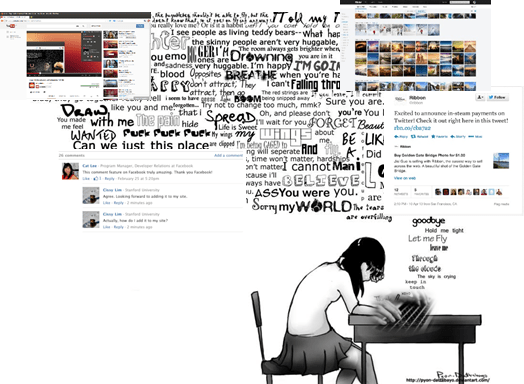
In the digital environment, users develop new social and cultural uses. One new life habit shared by many digital users is the editorialization. According to Bruno Bachimont (2007), the concept of editorialization designates an editorial activity from the indexed fragments of a document. The aim is no longer to find a document but rather to produce new ones using new resources.

Searching for online content and combining fragments of documents to generate substance, is a new way of writing/living in the digital. We believe that a person with disability can achieve an ample part of their network social participation by developing their online presence (Merzeau, 2010) and managing new forms of digital writing.

This general lecture was held in Al-Azhar University Indonesia in Jakarta on November 29th of 2016. To check the presentation: https://drive.google.com/open?id=0B0pzbHXvgDK8ZmZfaXBQdXNsRmc

To watch the interview : https://drive.google.com/open?id=0B-kLciZhjIfXZjBsZG1LVy11Z28
interview-with-hadi-s-a

Clubhouse connecté pour la population ayant des incapacités psychiques : pratiques numériques collaboratives, emplois de transition & communs de la connaissance

pic-2

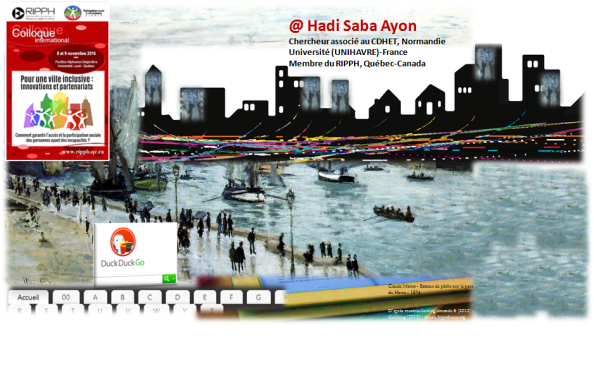
   Le modèle du clubhouse connecté que nous proposons dans cette présentation consiste à mettre en place une éducation au numérique, une première condition pour la “participation sociale en réseau” (Saba Ayon, 2016). Conçu pour une population ayant des incapacités psychiques, le clubhouse la connecte à l’environnement numérique qui modifie instantanément l’espace urbain et les pratiques de vivre dans la ville. L’objectif est de développer une présence numérique (Merzeau, 2010) qui favorise une bonne communication et une activité collaborative et participative. Face à une traçabilité numérique exploitée par les grandes firmes pour profiler les usagers, le numérique, dans une approche culturelle (Doueihi, 2013), devrait être investi dans des projets collectifs et mémoriaux pour faire des communs de connaissance (Mulot, 2016) utiles et efficaces à la personne et à sa communauté.

Ce travail a été présenté dans le cadre du Colloque International “Pour une ville inclusive : Innovations et partenariats”, organisé par le RIPPH et le CIRRIS à l’Université Laval à Québec les 08 et 09 novembre 2016.

Voir le support de la présentation : https://drive.google.com/open?id=0B0pzbHXvgDK8Tlg0QnZTS0YwNDA

Une vidéo de la présentation sera mise en ligne bientôt.

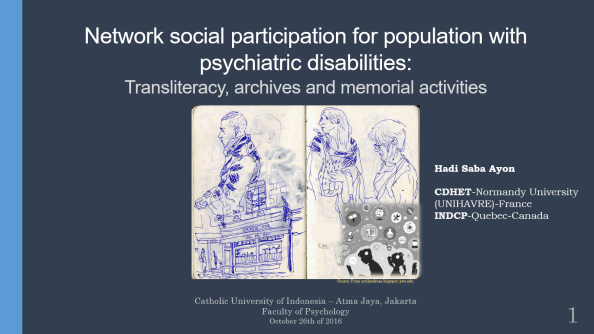
Network social participation for population with psychiatric disabilities:Transliteracy, archives and memorial activities

image1

How can the environment affects the social participation of persons with psychiatric disability? Based on the understanding of the disability in an anthropological and systematic approach as an interactive process (Fougeyrollas, 2010), our research perspective tries to introduce the digital culture (Doueihi, 2013) in the activities of the person in order to overcome the situation of disability. The procedure consists on developing new literacies and building an inclusive/adaptative environment.

This presentation took place in the Faculty of Psychology in Catholic University of Indonesia – Atma Jaya in Jakarta on October 26th of 2016.

To check the presentation: https://drive.google.com/open?id=0B0pzbHXvgDK8SWRUNjZzSVZZTW8