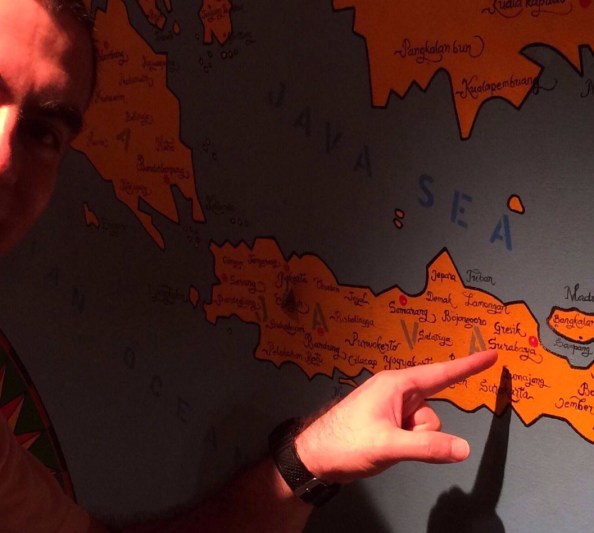
Surabaya, Indonesia ((Sabá, 2016)
Authors:
Hadi SABA AYON, Erlyn ERAWAN, Michael RAHARDANTO, Jaka SANTOSA SUDAGIJONO.
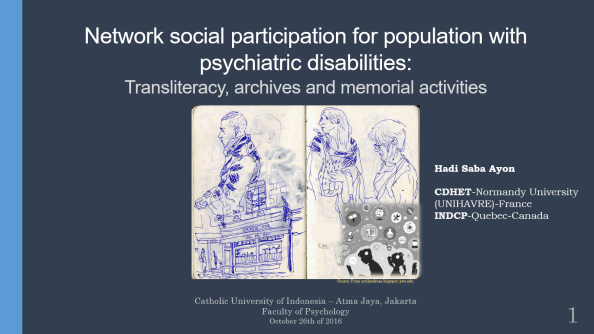
The social stigma of persons suffering from mental disorders is still prevalent in Indonesia. People are often embarrassed to go to psychologists or psychiatrists due to fear of being labeled as “crazy”. Disorganization characterizes the behavior of schizophrenics. Often, people blame “spirit possession” as the cause of an apparent behavior disturbance. As their personalities and capacities to achieve daily tasks are affected, they become dependent of their assistant environment to achieve their life habits (Fougeyrollas et al., 1998). How could digital environment (Doueihi, 2013) help them restructure their behavior and promote social participation? We interviewed assistants of schizophrenic patients in a psychiatric hospital in Lawang in Indonesia on October of 2016. This survey shed light on the perception from healthcare providers of mental disorders, and their understanding of digital and social participation. The content analysis of the interviews showed that the understanding of the problem of mental disorders is limited to difficulties the patients face in social interaction and communication. Moreover, patients lack the support of the social environment, who could help them overcome their sufferings. As for digital, it boosts the patient’s capacity to communicate and express oneself. On the other hand, it carries the risk of addictions and laziness. We call for a transliteracy for users to enhance their abilities in communication but also in treatment of digital information (to search, to organize, to share). We suggest a digital activity based on creating and developing an inclusive digital environment. This construction passes by producing and editorializing content (Vitali-Rosati, 2016) about their lives, their needs and their rights, then archiving these constructions (Crozat, 2016) in a collaborative memorial project. The aim is to attempt to organize information and communication of schizophrenic user by developing and practicing information and communication strategies to deal with the digital information and its structures.
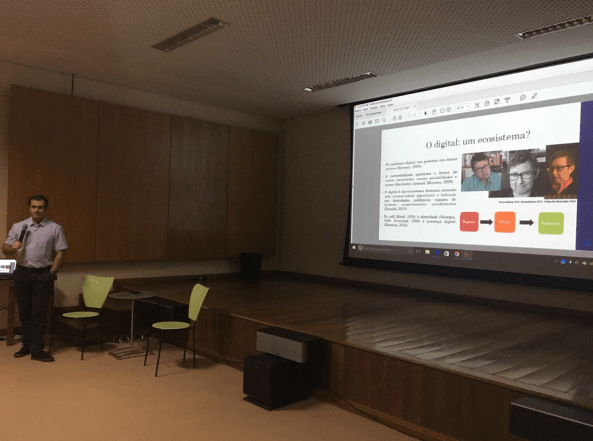
* This text is a collective contribution born from an international cooperation with Faculty of Psychology in Widya Mandala Catholic University in Surabaya in Indonesia. It was presented in the 3rd International Congress of Health Communication in Madrid (Spain) on October 19th-20th of 2017.
To check the program of the congress: http://www.aecs.es/ICHC2017_programa.pdf
– Dr. Hadi SABA AYON, Ph.D. in information and communication sciences, is an affiliated researcher to Faculty of Psychology in Widya Mandala Catholic University Surabaya in Indonesia.
Email: s.a.hadi@sabaeu.com
– Erlyn ERAWAN, Psy. D., is a researcher and lecturer in Faculty of Psychology in Widya Mandala Catholic University Surabaya in Indonesia.
Email: erlynerawan2@gmail.com
– Michael RAHARDANTO, M.A., is a researcher and lecturer in Faculty of Psychology in Widya Mandala Catholic University Surabaya in Indonesia.
Email: michaelrahardanto@gmail.com
– Jaka SANTOSA SUDAGIJONO, Masters, is psychologist, researcher and lecturer in Faculty of Psychology in Widya Mandala Catholic University Surabaya in Indonesia.
Email: jaka_s@ukwms.ac.id

 Sabáeu
You must be logged in to post a comment.