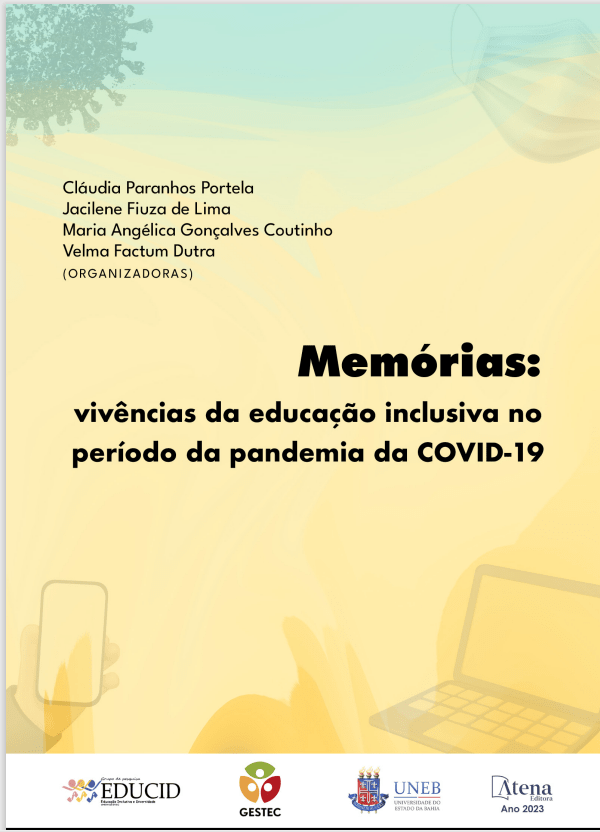
I had the pleasure to write in portuguese the Preface of the e-book Memórias: vivências da educação inclusiva no período da pandemia da Covid 19 directed by Professors Cláudia Paranhos De Jesus Portela, Jacilene Fiuza de Lima, Maria Angélica Goncalves Coutinho and Velma Factum Dutra from the University of Bahia State in Brazil (UNEB).
The preface is untitled: “RETOMAR OS RASTROS DIGITAIS PARA FAZER MEMÓRIA E FAVORECER A PARTICIPAÇÃO SOCIAL DE PESSOAS COM DEFICIÊNCIAS” (RECLAIM DIGITAL TRACES TO BUILD MEMORY AND PROMOTE THE SOCIAL PARTICIPATION OF DISABLED PEOPLE).
In the Preface I bring to the works on the culture of inclusion for disabled people a view about repossessing digital traces by building memories. I highlight on the digital traceability that characterizes our activities on the Internet. I emphasize the importance of developing digital skills and reinventing the digital space and the uses of the digital technology to help in achieving daily activities and social roles of disabled people. Finally, I call to produce and share digital cultural memories (conveying knowledge and good practices) that help to achieve life habits.
The e-book was published on October 2023 by Atena Publisher. It brings together scientific articles, letters from mothers and experience reports from various extension projects of the EDUCID research group at the University of Bahia State in Brazil, that were developed during the Covid-19 pandemic. EDUCID is the Special Education, Inclusion and Diversity Research Group linked to the Program of Management and Technology Applied to Education (GESTEC) at the State University of Bahia in Brazil.
The e-book gathers works that share theoretical and empirical experiences that transcended the home, isolation and social distancing, when collective life seemed to lose meaning and, at the same time, revealed the inexorable reason for human existence: community life.
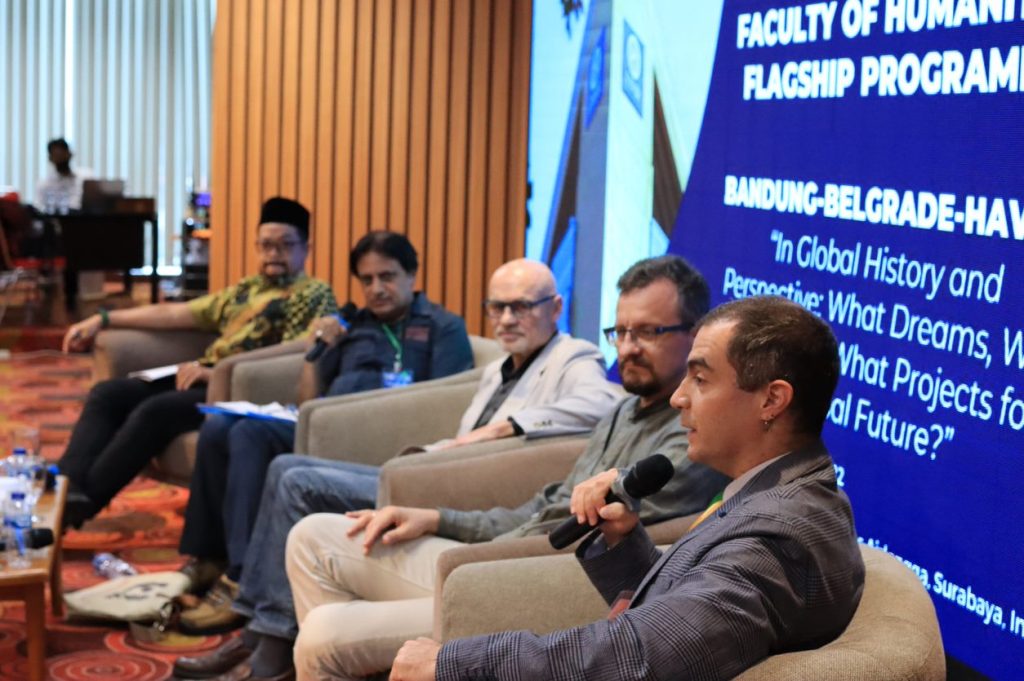
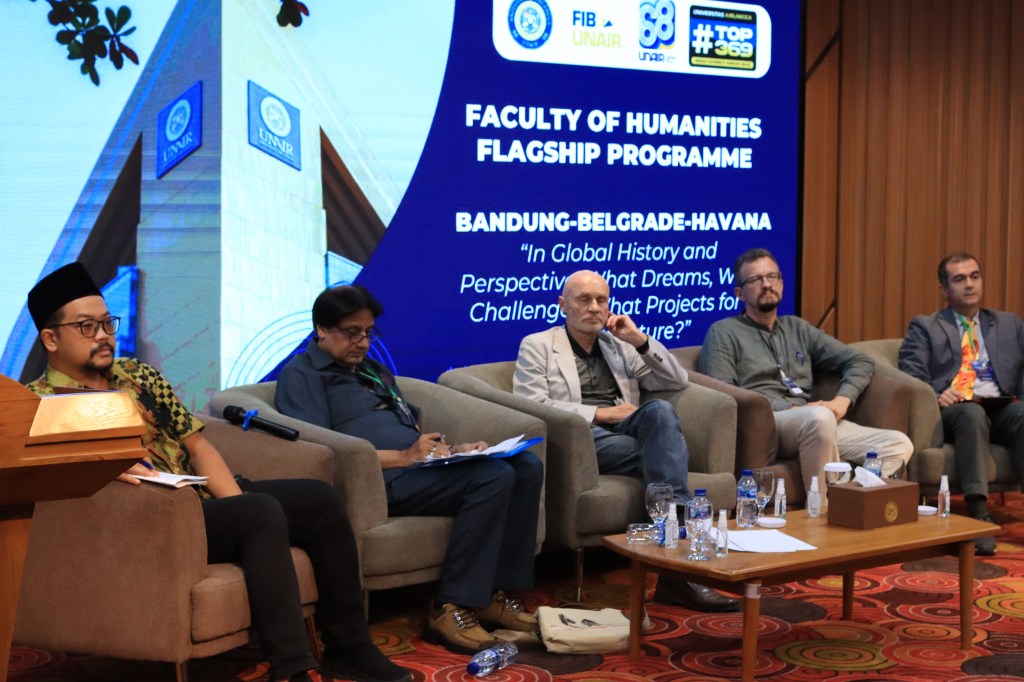
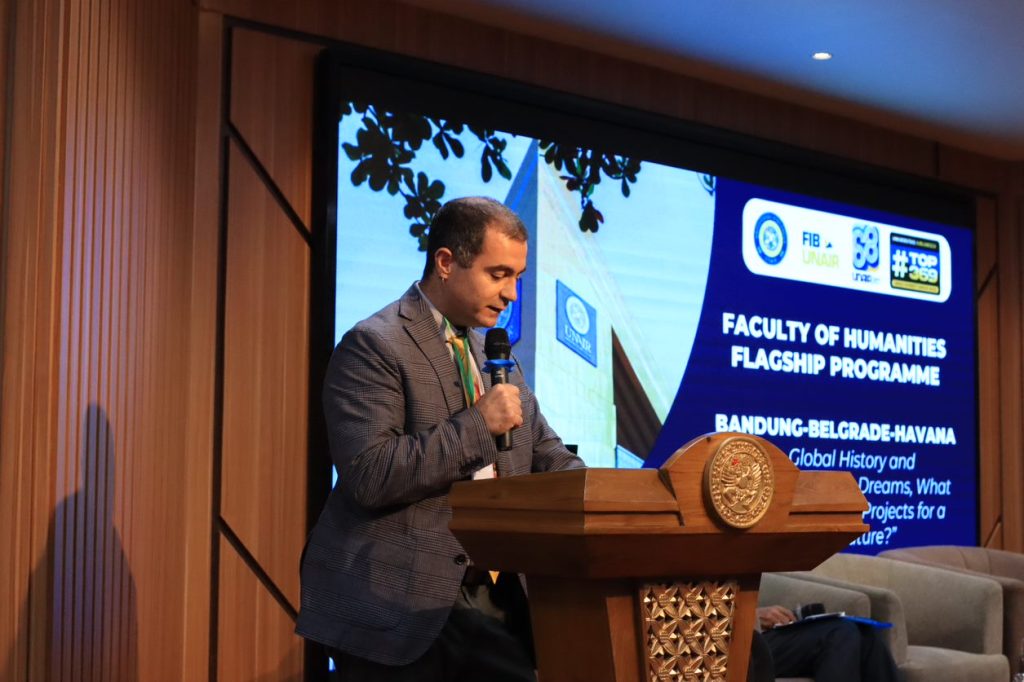
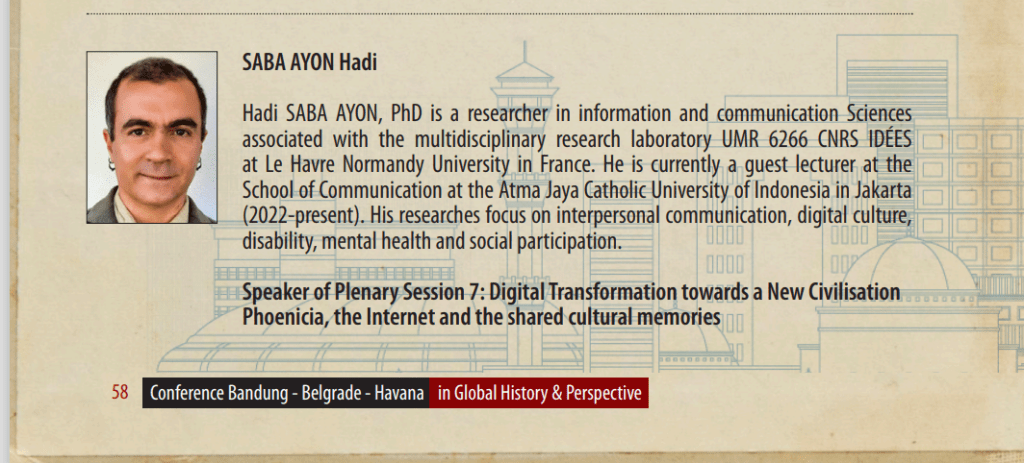
In the Digital Transformation Towards a New Civilization Plenary session at Universitas Airlangga in Surabaya (Indonesia): with Pr. Nisar Ul Haq (Jamia Milia Islamiya University, Delhi), Pr. Gracjan Cimek (Polish Naval Academy, Gdyna), Pr. Irfan Wahyudi (Faculty of Political and Social Sciences, Universitas Airlangga, Surabaya), and Wolfgang Pape (CEPS Centre for European Policy Studies, Bruxelles).
The title of our session, “Digital Transformation towards a New Civilization”, evokes several questions about the digital as a milieu/a civilization/a “new religion”, dare I say, and the transformations that its culture introduces in our lives. It reminds me of the French sociologist Dominique Cardon (2019), who writes in his book Culture numérique the following: “It is important to have varied and interdisciplinary knowledge to live with agility and caution (in a new world that digital enriches, transforms and monitors) because if we fabricate digital, digital also fabricates us”.
It leads us to think about the problems of our calculation society that encompasses connections between machines and the human being in its three versions:
A Human-trace (Ichnos Anthropos): who is a product and a producer of traces (especially of digital traces in this context);
A Homo economicus (Omo Oikonomikos): the human as a market actor;
and a Homo politicus (Oikonomikós Anthropos): a political animal intended to live in a polis, a city.
Digital has established itself as a new culture-changing our relationship to space, politics, things and ourselves. These transformations come from the interaction between intelligent machines (computers, then artificial intelligence) and users in innumerable fields and domains. These transformations became dynamics that characterized human society, turning it into an algorithmic society driven by a computing infrastructure. In this extensive environment/system (built from multiple layers), humans and machines are set up together – where our clicks, conversations, purchases, bodies, finances, and sleep become calculable data – a “new civilization” arises. The civilization of the Internet is known as the digital era. However, the Internet is not abstract. It is an object with a body, a language based on scientific operations, that generates new entities (digital traces) that restructure our reality. Furthermore, the most important is that it has a history. Moreover, this history interests us in analyzing and understanding so that we can deconstruct and adjust this civilization process.
The history of the Internet led us to search the history of old civilizations about common elements and contradictions that help us understand the mutations we are witnessing in our present. A comparative analysis between the Internet and Phoenicia seems essential to us. What relation can we find between an information and communication network and a model of urban city-states on the Mediterranean coast that existed more than three thousand years ago? In a brief explication that we will develop later in a presentation in another session, we can say that there are three intriguing aspects to be discussed:
The Internet has a body. It started as a public-military project before being privatized. Phoenician city-states experimented with the transition from a political and economic power from the royal palaces to a mercantile class.
The Internet has a universal language that allows anyone to connect and use. Phoenicians invented alphabetical writing that was accessible to all, and thanks to it, Phoenicia got its political entity.
The Internet is in crisis because of the privatization process that gave private firms the right to manage their actions for profit while neglecting the rights and needs of users. Phoenicia, characterized by trade activities, could not survive as a civilization and did not become a model of democracy and citizenship.
Talking about/remembering Phoenicia from a historical point of view concerning the Internet has a linkage to memory. Memory is the process of mobilizing resources, which aims less at restitution’s exactness than regeneration (Merzeau, 2017). Sharing a memory is not limited to this often interesting production of heritage objects disconnected from all social ties. It consists less of recording, storing or preserving traces than of embedding them in a common framework — whether a place, a rite, a device or a story. In our case, it is a study/analysis for a scientific purpose. Here, saying a word about memory in the digital context is essential.
Louise Merzeau, a French Professor and researcher from Paris 10 University who left us in 2017, and I had the honour to work with her for several years, demonstrates that the digital culture has introduced an anthropological mutation concerning memory. She writes that until the advent of the digital (le numérique), the fight against oblivion required an actual deployment of energy, tools and technological innovations. In other words, investing in archiving, preserving and building memories is needed digitally. It has introduced a break, even a reversal of this process: communication, production, registration and sharing systems via networks or digital media have generated automatic traceability, a condition of our activities and, therefore, before any real intention to “make a trace”. Today all efforts, technological means, knowledge and policies must no longer be used to memorize in traditional ways but to regulate oblivion, as the Internet is a kind of auto-memory, which is, in reality, an anti-memory. So the individual or the community decides what it wishes to transmit or, on the contrary, to erase. Moreover, as there is no memory without a thought of oblivion, it is therefore imperative to rethink oblivion collectively to regulate it and structure it so that it makes sense.
However, the Internet privatized does not give an option to its users to do that. That is why, getting back to our comparative analysis between the Internet and Phoenicia, we back the emergence of two proposals, one concerns the upper level of the Internet (what to do on the platforms), and the other is related to the lower level of the Network:
As digital writing is exhibiting new traces while pushing back others to be forgotten, the first suggestion is to transform our interaction in the digital into participation by developing individual or collective digital cultural memories. Our digital traces are removed from their contexts and scattered in the networks. They are alimenting the Big Data and used by private firms to make money. When we appropriate these traces in memory projects, they become commons, a part of a heritage policy that raises issues of knowledge. In this direction, we ensure a transition in the status of the digital user, from homo econimicus to homo politicus, from a market actor to a citizen/netizen (digital citizen) who has control over decisions with self-determination in the digital environment as well as in the social life.
The second proposal seeks the basement of the Internet. Let us not forget that the Internet is first made of pipes. Everything we do up the stack depends on these pipes working correctly. What if users and communities manage to hijack the privatization of the pipes and the monopoly of the Telecom companies and start creating their networks with the support of Public institutions with technical expertise and infrastructure? The purpose is to establish an Internet managed by community networks, an Internet that “places people over the profit”, as Ben Tarnoff (2022) says. In his Book Internet for the People: The Fight for Our Digital Future, Tarnoff writes, “The internet is not just material and historical, then; it is also political”. In this sense, our proposal is political, can bring people into new relationships of trust and solidarity, and encourages caring for collective infrastructure and one another.
Dear colleagues, dear participants, I am very pleased to welcome you to my 3rd course on Pandemic, gestures and memory at School of Communication at Atma Jaya Catholic University of Indonesia. In this 3-day workshop, we will talk about communication, digital culture, and writing and we will also write together. Writing is at the center of these sessions. Because at the base of digital culture there is Information Technology (IT). And as computer science is the techno science of information processing by automatic machines, all computer programming supposes discretization and formalization, in a word, writing. Thereby digital communication cannot exist outside the writing frame as one cannot NOT leave traces in digital environments. What are these traces and how can we distinguish a trace from an imprint from a sign? What are the challenges that digital traceability brings? What are the changes that Covid-19 pandemic brought to communication and what is its impact on digital transformation? In digital culture, there is the word “culture” that we will approach also in this work. In his Book Beyond Culture (1976), Edward T. Hall describes culture as models, templates; as the medium we live in; it is innate but learned; it is living, interlocking systems; it is shared, created and maintained through relationship; and it is used to differentiate one group from another.
Is it right to call digital a culture? If yes why? This will be one question among others that we will comment on the discussion online board (https://board.net/, from Fairkom) that you’ll find its link in the chat box. We will have other content to review and discuss during the course, and you’re welcome to transform your interaction into participation. We will try together to specify how to participate in online culture and what are the factors to take into account? The course, based on French and American works in different fields, emphasizes the importance of gestures in interpersonal communication, affected by Covid-19 pandemic and its consequences on human relationships. It exposes classic works from Chicago and Palo alto schools (20th century) and refers to recent reflections on Internet and digital culture given by Milad Doueihi [American-Lebanese historian of religions], Dominique Cardon [French sociologist], Louise Merzeau [Information and communication sciences – French school on Trace, who passed away on 2017 and I had the honor to work with her during my masters in Paris and my PhD in Le Havre in Normandy], Henry Jenkins [American media scholar], and others.
It approaches various notions that we use while talking about digital, as “trans-literacy” described by Merzeau (2014), and it forms to evaluate the information and the digital identity, and to learn how to filter and manage the digital presence. We will talk also about the post-human, described by Doueihi (2011) as “a consequence of the digital age, for it represents the ultimate expression of the new civilization inaugurated by the digital”. The post-human is, normally, a reference to the convergence of machine and man, to the possibility of intersection, within the body, of mind and computer. He stands as the perfect incarnation of the new individual generated by what Doueihi calls “the religious dimension of digital culture”.
With the growing engagement with the digital environment, the post-human is producing and exchanging more data, and ultimately is becoming a data consumer, a “human-data”. How to manage this data? Does it need to be preserved? Archived? One of the most neglected or forgotten aspects of digital culture is the impermanence or fragility of information and its material support.
This leads us to question how to deal with the accumulation of digital traces and their use for diverse purposes by different actors. Moreover, it takes us to question their availability, accessibility, security, and preservation. What happens to our traces? Are they saved and accessible anytime? Who owns them? Are they private or public? Could we delete some and keep others? Is Internet a universal memory? Digital traceability pushes us to question the memory and its characteristics in the digital era.
We will write together to participate and to build a digital memory that has its own properties and conditions, its governance, its rules and purpose; a network based memory connecting non-homogeneous memories and creating a digital community which brings together collective works that their authors / participants believe their contributions matter, and feel some degree of social connection with one another.
And as Henry Jenkins (2006) says: “Not every member must contribute, but all must believe they are free to contribute when ready and that what they contribute will be appropriately valued”. Thank you for your appreciated participation and let’s write together.
📢 DIGITAL COMMUNICATION COURSE 📢
The first course, "Pandemic, social participation and well-being," and the second course, "Disability: communication and social participation," were done successfully with an interactive discussion. pic.twitter.com/IDFULJ6Jel

 Sabáeu
You must be logged in to post a comment.